
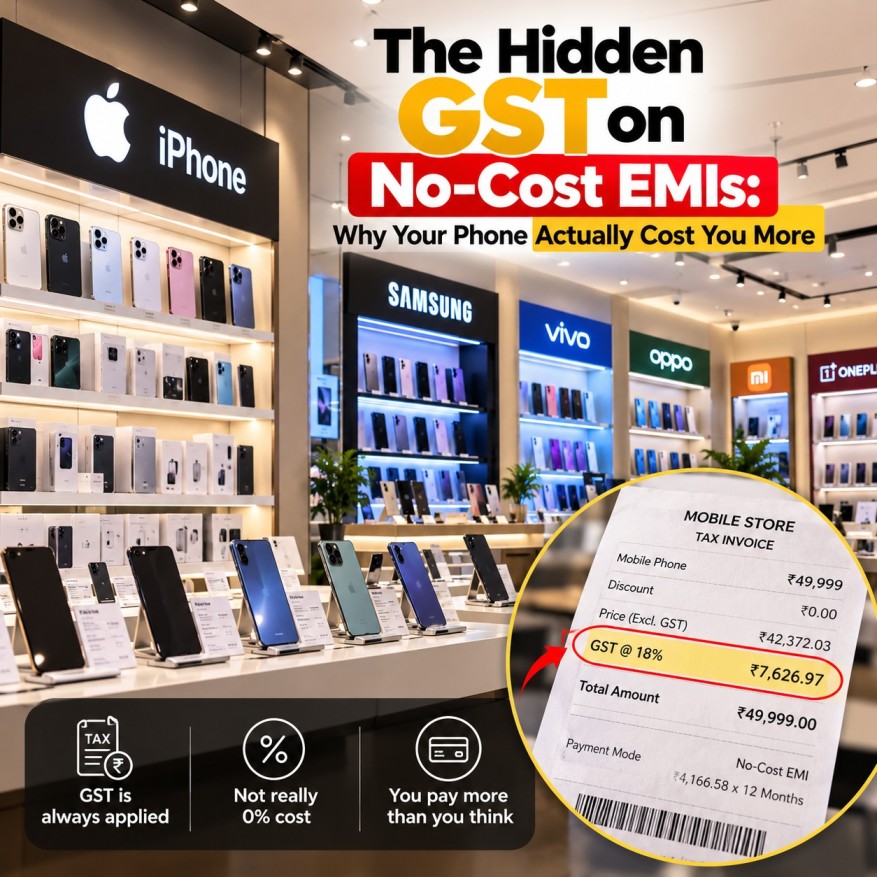
Buying a new smartphone has become easier with online shopping, attractive festive offers, bank discounts, and flexible payment options. Among these offers, No-Cost EMI is particularly appealing because it allows customers to purchase expensive smartphones through monthly instalments without paying the full amount upfront.
However, the term “No-Cost EMI” can create the impression that financing a smartphone comes without any additional expense. In reality, the final amount you pay may depend on the interest structure, GST on applicable charges, processing fees, and discounts you might lose by choosing an instalment plan.
One important detail consumers should understand is the hidden GST on No-Cost EMI, particularly the GST charged on taxable loan interest or processing fees where applicable. Even when a seller advertises zero interest, certain financing-related costs may still increase the total amount payable.
Before purchasing your next smartphone through No-Cost EMI, it is worth understanding how these charges work, why they appear on your bill, and how to calculate the actual cost of your purchase.
What Is No-Cost EMI?
No-Cost EMI is a payment option that allows customers to divide the price of a product into fixed monthly instalments over a selected period.
Instead of paying the entire smartphone price immediately, you pay a portion of the amount every month. Depending on the offer, the financing interest may be offset by an upfront discount from the seller or manufacturer.
For example, suppose a smartphone costs ₹60,000. You choose a six-month No-Cost EMI plan, which divides the purchase amount into six instalments of ₹10,000 each.
At first glance, the arrangement appears straightforward. However, the actual cost can differ if the offer includes processing fees, GST on taxable fees, or other disclosed charges.
The key point is that No-Cost EMI generally refers to the advertised interest benefit, not necessarily a guarantee that every aspect of the transaction is free.
How Does GST Apply to No-Cost EMI?
GST is a consumption tax that applies to specified taxable goods and services in India. When you purchase a smartphone, GST on the phone itself is generally included in its selling price.
Financing is a separate part of the transaction, and its tax treatment depends on the type of charge involved.
For instance, GST may apply to taxable processing fees or other taxable service charges associated with a loan. Interest on loans is generally exempt from GST, subject to the applicable rules and exceptions. Therefore, it would be incorrect to assume that GST automatically applies to every EMI instalment or to all interest amounts.
In some No-Cost EMI arrangements, the financing cost is offset through a merchant or manufacturer discount. In others, a lender may charge a separate processing fee.
Customers should examine the invoice, loan agreement, and applicable fee schedule to understand which charges are included and whether GST has been added to any taxable fees.
Why Can GST Increase the Cost of Your Purchase?
The additional expense usually arises when a taxable financing-related fee is charged separately.
Consider a hypothetical example in which a lender charges a processing fee of ₹500 and GST at 18% applies to that fee.
-
Processing fee: ₹500
-
GST on processing fee: ₹90
-
Total processing-related expense: ₹590
The customer pays ₹590 in financing-related charges, even though the EMI offer may advertise zero interest.
This example illustrates GST on a taxable processing fee. It does not mean that every No-Cost EMI plan charges this amount or that the same tax treatment applies to every financing component.
The Hidden Costs Behind No-Cost EMI
GST is only one factor that can affect the actual cost of a smartphone purchased through instalments. Other details of the offer can be equally important.
1. GST on Processing Fees
Some lenders or financing providers charge a processing fee for arranging the loan. Where the fee is taxable, GST increases the amount payable.
For example, a ₹999 processing fee with 18% GST would result in a total fee of ₹1,178.82.
Although the fee may appear small compared with the smartphone's price, it adds to the overall cost of financing.
Before accepting an offer, check whether the processing fee is zero, fixed, percentage-based, or subject to additional taxes.
2. Interest Offset Through a Discount
Many No-Cost EMI offers work by adjusting the interest cost through a discount provided by the seller, manufacturer, or another participating party.
This means the interest may not simply disappear. Instead, the offer structure compensates for some or all of the financing cost.
The important question is whether the advertised discount fully offsets the applicable interest and whether any other charges remain payable.
Customers should compare the final payable amount rather than relying only on the phrase “zero interest.”
3. Discounts Lost on EMI Purchases
One of the less obvious costs of No-Cost EMI is the discount you may not receive.
Imagine that a smartphone has a listed price of ₹60,000. A customer paying upfront is eligible for a ₹3,000 discount, but a particular No-Cost EMI offer does not permit that discount.
The customer may pay ₹60,000 through instalments instead of ₹57,000 upfront.
In this case, the difference is ₹3,000, even before considering any applicable processing fees.
This does not mean every EMI purchase loses the upfront discount. Some offers allow customers to combine discounts with instalment payments, while others have specific eligibility conditions.
Always compare the actual offers available to you.
4. Bank and Card-Related Charges
Some offers require an eligible credit card, debit card, or financing product. Depending on the terms, customers may encounter charges associated with the lender or payment provider.
These could include processing fees, applicable taxes on taxable services, or other disclosed costs.
The exact charges vary by provider, card type, transaction, and promotional terms. Read the relevant fee schedule instead of assuming that every bank or card charges the same amount.
5. Late Payment Charges
An EMI plan also comes with a payment schedule. If you miss an instalment, your lender may impose late payment charges or other amounts specified in the loan agreement.
Depending on the product and circumstances, missed payments may also affect your credit history.
These costs are not inherent to every No-Cost EMI purchase. They arise when the customer fails to meet the agreed repayment conditions.
Setting up payment reminders and keeping sufficient funds available can help prevent avoidable expenses.
No-Cost EMI vs Upfront Payment: A Practical Comparison
Consider a hypothetical smartphone purchase with the following details:
-
Smartphone price: ₹60,000
-
Discount available on upfront payment: ₹3,000
-
Effective upfront purchase price: ₹57,000
-
Total scheduled No-Cost EMI payments: ₹60,000
The comparison below excludes any additional EMI processing fees or other charges. Actual offers may differ.
| Purchase Detail | Upfront Payment | No-Cost EMI |
|---|---|---|
| Smartphone listed price | ₹60,000 | ₹60,000 |
| Upfront discount | ₹3,000 | ₹0 |
| Effective purchase price | ₹57,000 | ₹60,000 |
| Scheduled EMI payments | ₹0 | ₹60,000 |
| Additional financing fees | ₹0 assumed | Not included |
| Total cost in this example | ₹57,000 | ₹60,000 |
Cost difference: ₹3,000 in favour of upfront payment.
The comparison shows why an instalment plan advertised as interest-free may still be more expensive than paying upfront.
However, the result depends on the actual discount and financing terms. If the EMI offer also provides the ₹3,000 discount, the comparison would change. If taxable fees are added, the EMI option could cost more.
How to Calculate the Real Cost of No-Cost EMI
Before choosing an instalment plan, calculate the complete amount you will pay.
A simple comparison is:
Total EMI cost = Total scheduled instalments + upfront fees + applicable taxes on taxable fees + other mandatory charges
Then compare this amount with:
Total upfront cost = Smartphone price − eligible upfront discounts + any applicable upfront charges
For example, suppose the following hypothetical terms apply:
-
Smartphone price: ₹60,000
-
Total scheduled EMI payments: ₹60,000
-
Processing fee: ₹500
-
GST on the processing fee at 18%: ₹90
The total EMI cost would be ₹60,590, assuming there are no other charges.
If the same smartphone is available for ₹57,000 through an eligible upfront discount, the EMI option costs ₹3,590 more.
This calculation is illustrative. Before finalising a purchase, verify the actual instalment schedule, fees, taxes, and discounts offered for your transaction.
How to Avoid Paying More for No-Cost EMI
You do not necessarily need to avoid No-Cost EMI altogether. The right choice depends on your cash flow, available discounts, and the terms offered by the seller and lender.
Use these practical checks before making a purchase.
Compare the Final Payable Amount
Look beyond the advertised monthly instalment. Add together all scheduled payments, upfront charges, and applicable taxes to identify the real cost.
Read the Offer Terms Carefully
Check whether the advertised price includes an interest offset, whether the offer can be combined with other discounts, and whether a processing fee applies.
Ask for a Fee Breakdown
If the lender or retailer lists additional charges, ask for an itemised explanation. Confirm the fee amount, applicable GST, and whether the charge is mandatory.
Check Upfront Discounts
Compare the best eligible cash or upfront price against the complete EMI cost. A genuine saving depends on the difference between these final amounts, not just on the advertised interest rate.
Understand the Repayment Schedule
Confirm the number of instalments, the monthly amount, the due dates, and the consequences of missing a payment. Choose a plan that fits your monthly budget.
Keep the Documentation
Save the order summary, invoice, loan agreement, fee schedule, and promotional terms. These documents help you verify charges and resolve discrepancies if the amount deducted differs from what was disclosed.
Is No-Cost EMI Worth It?
No-Cost EMI can be a useful option for customers who want to spread a large purchase across several months without paying the full price immediately.
It may be particularly useful when the EMI offer preserves available discounts, carries no additional mandatory fees, and fits comfortably within the buyer's budget.
On the other hand, paying upfront may be more economical when a substantial discount is available only on immediate payment or when financing fees increase the total payable amount.
The best choice depends on three factors: the final purchase price, the total financing-related charges, and your personal cash-flow needs.
Instead of deciding based only on the phrase “No-Cost EMI,” compare the complete financial terms of both options.
Conclusion
No-Cost EMI can make a smartphone more affordable in the short term, but it does not automatically guarantee the lowest overall purchase cost.
GST on taxable processing fees, lost upfront discounts, and other applicable charges may increase the amount you pay. At the same time, GST does not automatically apply to every EMI instalment or every loan interest component, so it is important to distinguish between different types of charges.
Before purchasing a smartphone on instalments, read the offer terms, check the invoice and loan agreement, and calculate the total amount payable. A few minutes of comparison can help you understand whether the EMI offer genuinely saves money or simply makes a more expensive purchase appear affordable.
The smartest way to buy a smartphone is to compare the final cost, not just the monthly EMI.
Frequently Asked Questions (FAQs)
1. Is No-Cost EMI really free?
Not necessarily. The advertised interest cost may be offset by a discount, but processing fees, GST on taxable fees, or lost discounts can increase the total cost. Check the complete terms before purchasing.
2. Is GST charged on No-Cost EMI?
GST treatment depends on the specific charge. GST may apply to taxable processing fees or other taxable services, while interest on loans is generally exempt subject to applicable rules and exceptions. GST is not automatically charged on every EMI instalment.
3. How much GST is charged on EMI processing fees?
The applicable GST rate depends on the nature of the service and the relevant tax rules. If an 18% rate applies to a ₹500 taxable processing fee, the GST would be ₹90. Confirm the actual rate and fee with your lender.
4. Why can paying upfront be cheaper than No-Cost EMI?
A retailer may offer a discount for upfront payment that is unavailable under a particular EMI promotion. If the discount exceeds the EMI-related fees and any other relevant differences, upfront payment may cost less.
5. Does No-Cost EMI affect my credit score?
Applying for or using a credit-based financing product may affect your credit profile depending on the lender's reporting practices and your credit history. Missed payments can negatively affect your credit score.
6. How can I check whether a No-Cost EMI offer is beneficial?
Compare the total scheduled instalments, upfront fees, applicable taxes, and other mandatory charges with the final upfront price after eligible discounts. The lower total cost is generally the more economical option, provided it also suits your financial needs.
7. Can I get a refund of GST charged on EMI processing fees?
GST charged on a taxable fee is not automatically refundable simply because the purchase was made through EMI. Any refund depends on the transaction, the applicable rules, and the provider's refund policy. Contact the lender or seller if you believe a charge was incorrect.
Disclaimer: This article is for general informational purposes and does not constitute tax, legal, or financial advice. GST treatment and financing terms may vary according to the transaction and applicable regulations. Verify the current rules and your lender's terms before making a purchase.