
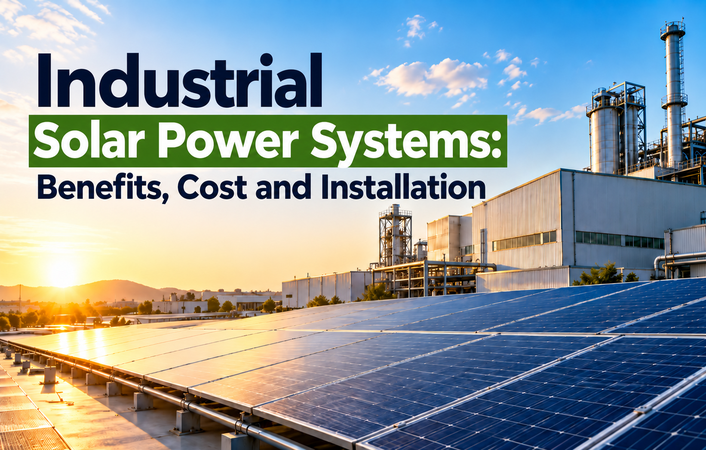
Why Are Vasai Businesses Exploring Industrial Solar Energy?
For a manufacturing business, every production cycle depends on reliable electricity. From operating machines and compressors to maintaining warehouse lighting and ventilation, power consumption influences how efficiently a facility runs. For industrial businesses in Vasai, Maharashtra, understanding alternative energy options can be an important step towards better cost management.
Industrial solar power offers a different approach to electricity planning. Instead of obtaining all the required energy from the grid, a business can generate part of its daytime electricity through a solar installation on its premises.
The value of this investment depends on how the facility operates, how much electricity it consumes and whether its building can accommodate a suitable solar array. Uzonmart presents this guide to help business owners understand the practical considerations behind industrial solar technology, project expenses, and installation planning.
How Does an Industrial Solar System Work?
Think of an industrial building as a place that consumes electricity throughout the working day. A solar installation adds an electricity-generating system to that property. Solar modules capture sunlight and produce direct current electricity. An inverter converts this electricity into alternating current suitable for compatible electrical loads. In a grid-connected arrangement, the solar installation operates alongside the existing electricity supply according to the approved system design.
The electricity generated can contribute towards the operation of machinery, lighting, office equipment and other connected loads. Any shortfall can be supplied through the existing arrangement, subject to the system configuration. A solar installation is not automatically a backup power source during an outage. Backup functionality depends on the inverter, battery storage, electrical configuration, and applicable safety requirements.
For businesses in Vasai, understanding these technical differences is important before deciding which type of system to install.
Five Ways Industrial Solar Can Change Business Energy Planning
1. Daytime Electricity Generation
Factories that operate during sunlight hours may be able to use solar electricity while their equipment is running. This can reduce the quantity of electricity they need to purchase from the grid.
The benefit depends on matching solar production with actual consumption. A facility that uses most of its electricity during the day may have a different savings profile from one that operates primarily at night.
2. A New Purpose for Available Roof Space
An industrial roof can provide space for electricity generation without requiring a separate plot of land. However, the usable area is not necessarily the same as the roof's total area.
Walkways, water tanks, ventilation equipment, shadows, and maintenance access can limit panel placement. The roof's structural capacity and weatherproofing also need attention. A site assessment can establish whether rooftop installation is technically practical for a factory or warehouse in Vasai.
3. More Informed Electricity Budgeting
Solar investments should be evaluated using actual electricity consumption rather than a general promise of savings.
By reviewing electricity bills and operating schedules, a business can estimate how much solar energy it might consume directly. This provides a more useful basis for comparing the project cost against potential reductions in electricity expenditure.
4. Energy Planning for Future Expansion
When a business adds machinery or increases production, its electricity requirements may change. Planning for these possibilities during the initial solar assessment can help avoid an unsuitable system design.
Future expansion is not always straightforward. Available space, inverter capacity, electrical infrastructure, and utility permissions can influence whether additional solar capacity can be installed later.
5. Progress Towards Environmental Objectives
Generating electricity from sunlight avoids direct fuel combustion during solar power generation. The overall emissions benefit depends on the electricity source being displaced and the lifecycle impacts of the equipment.
Businesses interested in sustainability can document their solar generation and electricity consumption to support their internal environmental reporting.
What Determines the Cost of an Industrial Solar Project?
There is no universal installation price for every industrial property in Vasai. Two buildings with similar electricity bills may require different equipment and installation work because their roofs, electrical systems, and operating conditions differ.
The total project budget should be examined through the following components.
Generation equipment: Solar modules and inverters form the core of the installation. Their capacity, specifications, efficiency, and manufacturer influence the equipment selection.
Building preparation: Some roofs may require structural work, mounting adjustments or waterproofing attention before panels can be installed safely.
Electrical integration: Connecting a solar installation to an existing industrial electrical system may involve cabling, protection devices, earthing, and distribution equipment.
Monitoring and safety: Suitable monitoring equipment and electrical protection help operators assess performance and identify faults.
Storage requirements: A project that includes batteries for backup or energy storage has additional equipment and installation costs.
Approvals and commissioning: Applicable utility procedures, metering arrangements and technical requirements should be included in project planning.
Ongoing ownership expenses: Maintenance, cleaning where necessary, equipment servicing and eventual replacement of components can affect the overall cost of ownership.
For a reliable estimate, businesses should request a written proposal that identifies the system capacity, equipment models, installation scope, exclusions, warranties, and estimated annual generation.
How Can a Business Judge Whether Solar Is Financially Worthwhile?
A solar project should be evaluated against the electricity it is expected to replace, not simply against the number of panels installed.
Start with three pieces of information:
-
The facility's annual electricity consumption.
-
The amount of solar electricity expected to be used on-site.
-
The applicable cost of the electricity that this solar generation would replace.
Consider a hypothetical industrial unit that uses 90,000 units of solar electricity directly over a year. If the relevant avoided electricity cost is ₹8 per unit, the estimated gross value of that electricity is ₹7,20,000 annually.
This calculation does not represent a guaranteed saving. Fixed charges, demand charges, maintenance, financing, and other tariff components may not decrease in proportion to the number of units generated.
The next step is to compare the estimated net annual benefit with the complete installation investment. A realistic assessment should also account for system degradation, downtime, future maintenance, and the expected period of ownership.
For businesses in Vasai, this approach can help distinguish a financially suitable installation from one that looks attractive only on the basis of its initial sales quotation.
Planning an Industrial Solar Installation in Vasai
Successful installation begins before any equipment reaches the site. A structured planning process helps businesses identify technical requirements and avoid preventable changes during construction.
Stage 1: Understand the Facility
Collect recent electricity bills and review operating hours, connected loads, and consumption patterns. This information provides the foundation for deciding how much solar generation the business could use.
Stage 2: Examine the Property
Assess the roof or available land, including structural condition, shading, access, drainage and the proposed location of electrical equipment.
For an industrial shed, the mounting solution must be appropriate for the building's construction and local site conditions.
Stage 3: Develop the Technical Proposal
The proposed design should explain the planned capacity, panel layout, inverter arrangement, expected energy production and connection method.
The financial proposal should distinguish equipment and installation costs from optional services or additional work.
Stage 4: Confirm the Applicable Requirements
Before construction and connection, establish which utility approvals, metering arrangements, electrical inspections and commissioning procedures apply to the project.
Requirements can differ according to the installation type and connection arrangement, so they should be verified for the particular site.
Stage 5: Complete Installation and Testing
The installation team fits the equipment and completes the electrical connections according to the approved design and applicable safety requirements. Testing and commissioning must be completed before the system is placed into normal operation.
Stage 6: Track Actual Performance
After commissioning, compare recorded electricity generation with the original estimates. Monitoring can help identify shading changes, equipment faults, or unexpected performance losses.
Maintenance should follow the equipment manufacturer's recommendations and the actual conditions at the site.
Selecting an Industrial Solar Partner: Questions Worth Asking
The lowest quotation does not necessarily represent the best long-term investment. Businesses should understand exactly what they are purchasing and who will be responsible for each part of the project.
Before making a decision, ask the proposed installer:
-
Has the company assessed the actual building and electricity consumption?
-
Are the equipment brands, models and capacities clearly identified?
-
Does the quotation include electrical protection and earthing?
-
Who will coordinate the applicable approvals and commissioning?
-
What do the equipment and workmanship warranties cover?
-
Is performance monitoring or post-installation maintenance available?
-
Which costs are excluded from the quoted amount?
For an industrial facility in Vasai or the surrounding Vasai-Virar region, these questions can help establish whether a proposal is technically complete and financially transparent.
Is Solar Suitable for Every Industrial Building?
Not necessarily. A factory with substantial daytime electricity use and an appropriate roof may have different opportunities from a facility with limited roof space, extensive shading, or predominantly night-time operations.
A building may also require structural improvements before installation. Some businesses may benefit from battery storage, while others may find that a grid-connected arrangement better suits their operating pattern.
The correct decision comes from evaluating the property's physical conditions, electricity requirements and financial objectives together.
Industrial solar should therefore be treated as a site-specific energy investment rather than a standard package that works identically for every business.
Frequently Asked Questions
What should a factory check before installing solar panels?
The business should review electricity consumption, available roof space, structural condition, shading, electrical infrastructure, expected generation and project cost. Applicable utility requirements must also be established.
How is the cost of an industrial solar system calculated?
The budget depends on system capacity, equipment specifications, mounting arrangements, electrical integration, installation complexity, and any battery storage or structural work required. A site-specific quotation provides a more reliable estimate than a generic price.
Can industrial solar reduce monthly electricity expenses?
It can reduce purchased electricity when the system generates power that the facility can use directly. The actual financial effect depends on the electricity tariff, consumption schedule, system performance and applicable charges.
Can a solar installation provide electricity during a grid outage?
Not every grid-connected system can do so. Backup operation requires compatible equipment and an appropriately designed configuration, which may include batteries and additional protection arrangements.
How can industrial solar performance be monitored?
Monitoring equipment can record energy generation and help identify unexpected changes in system performance. Comparing actual production with expected output helps businesses evaluate whether the installation is operating as planned.
Should businesses in Vasai consider rooftop or ground-mounted solar?
The choice depends on available space, roof suitability, site layout, electricity requirements and applicable permissions. A technical site assessment should determine which option is practical.
Final Thoughts: Making a Better-Informed Solar Investment
Industrial solar power can give businesses another way to plan electricity generation, use available property more productively and evaluate long-term operating expenses. Its financial value, however, depends on the relationship between installation cost, actual electricity generation, and the facility's consumption pattern.
For businesses in Vasai, a sensible starting point is to review electricity bills, inspect the proposed installation area, and obtain a transparent technical and financial assessment.
Uzonmart provides this guide to help business owners understand the decisions involved before exploring industrial energy solutions. Careful evaluation, appropriate equipment selection, and a well-planned installation can help businesses determine whether solar power fits their operational and financial objectives.